.png)








How Do You Localise Your Employer Branding Strategy for the UK BFSI Sector?
Workforce expectations continue to shift across the UK’s banking, financial services and insurance sector, changing how organisations engage both employees and prospective talent.
Robert Walters Talent Trends report describes an “engagement recession” affecting organisations globally, contributing to an estimated US$438 billion in lost productivity. While that finding focuses on existing employees, it raises a related consideration for Talent Acquisition teams: how does an organisation create interest and trust among people who have not yet joined?
For specialist areas such as risk, compliance, technology and actuarial work, employer brand can play a role before a vacancy is advertised. A clear employer branding strategy can help organisations explain what they offer as an employer, what differentiates the employee experience and why that may matter to particular talent groups.
What is Employer Branding Strategy?
An employer branding strategy is broadly an organisation’s framework for managing and defining its reputation among current, potential, and former employees. In today’s talent market, this goes beyond passive corporate positioning, a strategic employer brand acts as a commercial lever that communicates a company's unique culture, values, and Employee Value Proposition (EVP), essentially answering why specialist talent should choose to work and stay with your organisation.
Benefits of Good Employer Branding
Employer branding is often associated with attraction, but its influence can continue throughout the recruitment process. When competing for specialist talent in high-demand functions like risk, compliance and actuarial science, a well-defined employer brand is a critical headstart, creating sustained candidate interest even before roles are opened. Besides shortening time to hire, improving offer acceptance rates, and reducing the cost of attracting qualified candidates over time, an organisation can potentially see a boost in employee retention by reinforcing their reasons to stay.
From a commercial perspective, organisations with a credible, consistently communicated employer brand have shown to spend less to hire better people, more quickly.
This is however contingent on effective localisation. A global employer brand provides consistency, but the way that brand is expressed locally may need to reflect different priorities, career expectations and market conditions.
Employer Branding Examples for Financial Services Employers
Employer branding in UK's banking and financial services industries can take many forms, but one of the most effective approaches directly target candidate expectations. Driven by regulatory shifts and modern employee expectations, top professionals increasingly prioritise corporate trust, transparency, defined progression, and metrics beyond traditional compensation structures.
The Robert Walters Salary Survey 2026 highlights that British BFSI professionals rank enhanced wellbeing strategies, compensation and benefits, and flexible working as their top considerations. A targeted UK employer branding strategy would therefore directly address pay clarity, adjacent physical and mental health initiatives, and appropriate work arrangement models to attract its best specialists.
Furthermore, as financial institutions invest heavily in fintech integration and cloud architecture, you’re not just competing with other banks, but also major technology firms for data scientists and software engineers. A different candidate profile demands different priorities, and therefore your employer brand must actively showcase investments in areas like cutting-edge infrastructure, structured technical development, and clear upskilling pathways.
Whether you seek to attract early careers talent for highly technical skillsets, or experienced industry veterans to fast-track time-sensitive projects, good employer branding will demand process consistency: the same proposition communicated credibly across candidate touchpoints, from job advertisements and career sites through to the recruitment process and onboarding experience itself.
How to Develop a Localised Employer Branding Strategy?
A local approach does not need to replace the global employer brand. For many organisations, the more useful question is how the core EVP can be expressed in ways that make sense to a specific talent market.
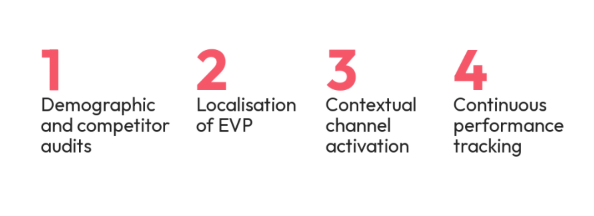
Step 1: Demographic and competitor audits
Here, you will seek to identify regional talent groups and their key demands. Talent-market research can help HR and TA teams understand where suitable candidates are based, what other organisations are competing for them and which employment factors are influencing movement.
Competitor activity can also provide useful context. The purpose is not necessarily to copy another employer’s proposition, but to understand what candidates are seeing elsewhere and where an organisation may have something distinctive to communicate.
This becomes particularly useful for specialist roles where the available pool is relatively small.
Step 2: Localisation of EVP
With your core brand values as the base, you now translate global corporate ethos to regionally relevant commitments. Quantify and justify as needed. For example,
Global message: professional career growth
Local adjustment: support for regional certifications and regulatory upskilling
Global message: flexible working
Local adjustment: locally competitive hybrid arrangements, parental and childcare leave policies
“In competitive hiring markets, the strongest organisations stand out by treating applicants the way great brands treat customers: with care, clarity, and experiences built around the candidate, not internal processes.”- Isla Smith, Global Head of CX, Robert Walters
Step 3: Contextual channel activation
Now that your localised setup is ready, the next step is deployment. The media mix must complement the candidate profile. Job boards and paid media may be appropriate for some talent groups. Others may be easier to reach through professional communities, industry events, social platforms, university relationships or direct engagement.
A graduate campaign, for example, will usually require a different approach from engagement with senior compliance or technology professionals. Some approaches could include, industry events, social media, and organic talent networks.
Step 4: Continuous performance tracking
Application numbers can show whether a campaign is generating attention, but they provide only part of the picture. Further down the recruitment process, applicant quality, interview progression, offer acceptance, candidate withdrawal and time to hire may offer a clearer view of whether the employer message is reaching the intended audience.
Candidate feedback can add another layer. If people are interested in the organisation but consistently leave the process at the same point, the issue may not sit with attraction at all. Looking at several measures together can help HR and TA teams decide whether the message, audience, channel or recruitment experience needs further attention.
How Recruitment Process Outsourcing (RPO) Can Support Employer Branding
Managing distinct, localised brand messaging across multiple sites can place a significant strain on internal HR and Talent Acquisition departments. This operational complexity is a primary reason why business transformation leaders choose to partner with specialised enterprise providers.
When looking for a partner, it is important that they can reconcile your organisation’s talent objectives, the proposed employer branding strategy shaped to target said objectives, and the data and insights utilised to reach these conclusions.
Alongside your day-to-day recruitment operations, an RPO partner with an eye on your long-term talent strategy should also possess:
- Talent market intelligence: RPO teams utilise advanced analytics to provide real-time salary benchmarking, regional talent mapping, and competitor brand analysis across the UK market.
- Content and proposition marketing: Utilising deep expertise in tailored marketing solutions, partners can design and execute brand campaigns tailored to your specific regional, demographic, or technical requirements.
- Application volume management: In an environment where generative AI tools allow candidates to submit high volumes of generic applications, an experienced RPO partner reinforces human judgment, selecting genuine high-quality, aligned applicants rather than simply increasing raw volume.
Connecting Employer Brand With Business Priorities
In a highly competitive hiring market, businesses that fail to localise their employer brand strategy risk falling behind. However, when done right, the benefits of localised, nuanced employer branding will go beyond short-term improvement of applicant quality and reduced time-to-fill. Our webinar on-demand, Winning talent in APAC: employer brand in the age of AI, brings together our suite of talent marketing experts and partners to quantify the costs and benefits of employer brand initiatives in the APAC region.
Alternatively, if you are ready to evaluate your recruitment and build a scalable inbound pipeline of motivated, empowered professionals, reach out to us and have our strategic talent advisors diagnose and consolidate your regional talent strategy.
Meet our expert RPO team

Robert Brighton
Global Head of Sales Enablement
Drawing on 12+ years' recruitment experience, Robert helps clients unlock growth through tailored outsourcing solutions, sharing market insight and shaping strategies focused on long-term impact and excellence.

Bianca Bounds
Global Client Success Manager
With over a decade of experience across recruitment and procurement, Bianca brings together stakeholders, shares market insight, and co-creates practical, fit-for-purpose talent solutions for every client.
FAQs
-
Why does generic employer branding fail to attract talent?
Standardised corporate branding lacks the specificity needed for regional talent pools. When compared to a competitor that actively localises and revises their EVP, your firm may have to pay a premium to attract the same talent, suffer higher employee turnover when said specialists realise the disconnect between your global brand and local reality, and and ultimately face poorer time-to-fill metrics and delayed business objectives. -
What are the primary workplace motivators for British BFSI candidates?
Modern UK finance specialists look for corporate integrity, transparency, and clear career progression. Their top priorities include wellbeing programmes, transparent compensation, and hybrid working models. Additionally, because financial firms now compete with major tech companies for digital talent, your brand must explicitly showcase investments in advanced technology infrastructure and technical upskilling pathways. -
What are some model examples of employer branding localisation?
The most effective localised EVPs consider the target candidate groups’ region- and industry-specific demands. Accounting for local candidate motivations can look something like this:
- Shifting a global message of "continuous career growth" to a local promise of "funding for UK regulatory certifications and compliance upskilling."
- Refining a broad "flexible working" policy into "locally competitive hybrid structures, enhanced parental leave, and localised childcare support initiatives."
-
How can an outsourcing provider help with an employer's EVP?
Balancing unique regional messaging overburdens internal talent teams. A Recruitment Process Outsourcing (RPO) partner scales this complex process by providing localised market intelligence and bespoke talent marketing campaigns. On top of this, an RPO partner can also manage the rest of the recruitment process, including screening for genuinely qualified talent amid an explosion of AI-generated CVs.
Related content
View All
Embarking on a global expansion strategy is an exciting, yet complex undertaking. While attention often turns to market entry, legal frameworks, and operational logistics, the single most critical factor for success, especially in an offshoring model, is accurately defining and acquiring the right t
Read More
Skills-Based Hiring: Solving the Graduate Jobs Crisis The graduate job market is facing unprecedented challenges. Entry-level vacancies in white-collar sectors have dropped by as much as 35% over the past 18 months, leaving many graduates struggling to secure their first role. In a recent interview
Read More
In 2025, artificial intelligence (AI) is not just a buzzword – it is becoming a critical part of hiring processes and career development. AI is rapidly reshaping the hiring landscape, revolutionising how organisations identify, assess, and onboard talent, while also placing a spotlight on the indisp
Read More