.png)








What Is Headcount Planning?
Headcount planning is a strategic approach to estimate how many employees a business will need over a set period, where those roles sit and when do they need them. Most plans start with reviewing the current workforce, then consider the expected departures, replacement hiring, new roles and shift in business priorities.
An enterprise business may tend to break the work further: by team, market, job family, seniority or start date. This is especially useful considering a headcount plan typically would involve many departments within the business. Finance tends to care most about the cost attached to each headcount. While HR watches how teams are growing or reshaping, the Talent Acquisition team reads the same numbers for what they mean for upcoming recruitment demand.
The number of hires required on its own doesn’t say much about the difficulties in hiring for a role. Hiring additional headcounts for the operations team is one type of difficulty while hiring a group of cyber security or risk specialist could take months of market mapping before a single candidate is in front of the hiring manager. Therefore, a strong headcount plan provides context behind each number. This includes what work is being added, what skills it needs, where are those skills current available and when we need people in those roles.
What Is the Difference Between Headcount Planning and Workforce Planning?
Headcount planning and workforce planning often are used within the same conversation. They are closely related but workforce planning typically looks at the broader set of decisions. While headcount planning is concerned with how many people the business expects to need, workforce planning looks at the skills and capacity behind those numbers. It also takes one step further to consider how the business plans to get hold of them.
Imagine that your business calls for ten new roles in a growing team. Looked at through a workforce lens, that same demand could split into seven permanent hires, two roles filled through internal moves, and one requirement that only exists for the length of a single project. Everest Group research from 2026 reflects the closer relationship between Talent Acquisition and these wider workforce decisions, with 46% of respondents identifying stronger workforce planning aligned to future skills as an expected TA outcome.
For HR leaders, the distinction becomes particularly useful when the business is entering a new market, adding specialist or niche skills or preparing for a significant increase in hiring. The question is no longer only how much headcount is approved, but how that workforce demand can realistically be met.
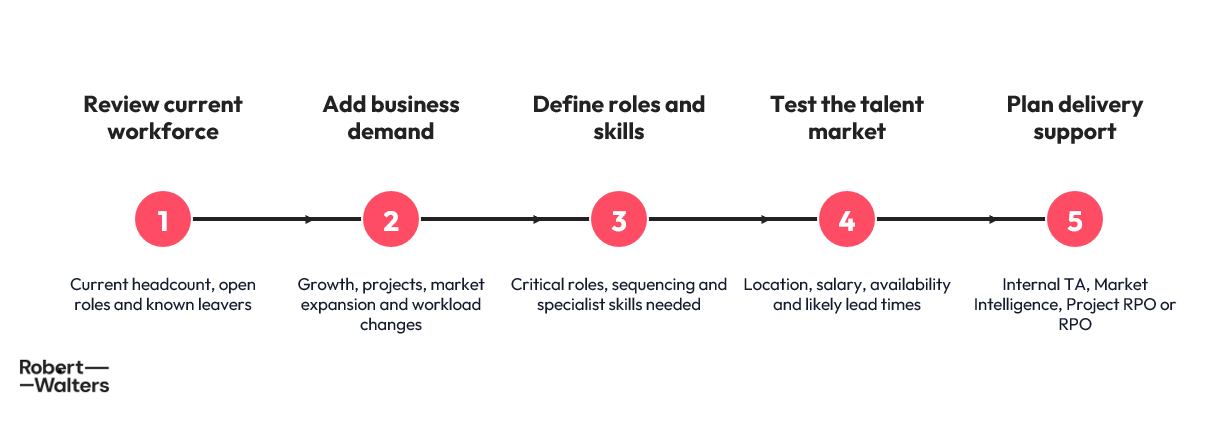
How to Build a Headcount Planning Process
A strong headcount plan starts with what is already known, then adds the changes the business expects to make. From there, HR and TA can test whether the hiring plan is realistic and decide what support may be needed to deliver it.
How to Turn Headcount Planning into a Recruitment Plan
When turning an approved headcount plan to recruitment, most teams will discover that timelines are crucial. The recruitment journey consists of sourcing, interviews, internal approvals, offers and candidate notice periods should be considered when planning to hire. A role planned to be filled by September cannot necessarily begin recruitment in September.
The time-to-hire also varies by role. A high-volume operational role may move through the process quickly, while a senior technical or specialist regulatory position might need a longer time to search.
With the headcount plan, it gives TA teams to identify those gaps early on while also tackling the business hiring request more strategically. Roles can be grouped by expected recruitment lead time, the hiring volume, which roles are of business priorities and talent availability in the market so that the team knows where candidate pipelines need to be built in advance.
It also surfaces capacity questions early. If the internal team is used to a steady flow of hiring and the new plan adds a sharp increase on top, there's time to work out how that gets covered, rather than discovering the gap once recruiters are already stretched.
How Market Intelligence Supports Headcount Planning
As much as business leaders can plan to hire, most of the time the reality of hiring can look very different. Candidate pools may vary from market to market, especially if the business do not have data to back up their findings.
Salary expectations is one of the most common assumptions when businesses are trying to hire in a new market. With no visibility and understanding of the location, it may deter candidates from pursuing the same company in the future. Businesses also sometimes surprised by the smaller talent pool in a preferred location that what was anticipated in the planning stage. In some markets, there are competitors who may be hiring from the same pool.
To support their planning, businesses with market intelligence give HR and TA leaders an opportunity to address those assumptions before recruitment begins. If a business wants to build a cyber security team in Manila, for example, talent data can provide a view of candidate availability, salary expectations, competitor demand and likely hiring timelines. The result may confirm the original plan, or it may prompt a discussion about starting earlier, considering another location or reviewing part of the role profile. This type of insight is particularly useful when headcount is being added in a new market or when the business is planning several specialist hires at the same time.
When RPO and Project RPO Fit into Headcount Planning
HR and TA leaders typically weigh up outsourcing once hiring volumes have already peaked and the internal team can't keep up. Headcount planning offers an earlier window to spot that pressure coming. Take an internal TA team that typically delivers around 100 hires a year: the next plan adds 60 more roles across two markets, including a group the team has little experience recruiting for. Before a single requisition opens, there's a reasonable signal the coming year won't look like business as usual, and that's worth exploring whether Recruitment Process Outsourcing (RPO) has a role to play.
That doesn't mean the entire recruitment process has to move outside the business. It means HR can work out in advance whether the internal team has enough capacity, market knowledge and sourcing reach to deliver the plan, and where RPO might help close the gap.
RPO can support part or all of the permanent recruitment identified through the headcount plan, and the scope tends to follow the shape of the demand rather than a fixed default. Where volumes are sustained across several teams, job families or markets, a wider RPO model can provide ongoing sourcing, delivery, reporting and coordination with hiring managers. Where the requirement is more defined, such as a market launch, seasonal hiring, a group of specialist vacancies or a temporary spike, Project RPO tends to fit better.
Both models also bring market information into the planning process: insight from a partner already recruiting in that space on candidate availability, hiring timelines, and how the business is likely to compete for the talent it needs.
The split between internal TA and an outsourcing partner doesn't have to look the same for every employer. The strongest arrangements are built around what the internal team wants to retain, where extra capability is genuinely needed, and how both sides work together once hiring begins.

Case Study: Preparing for a Hiring Peak
Robert Walter’s client, a global fashion retailer in Malaysia faced this situation when peak seasonal hiring coincided with their TA lead going on maternity leave. The business needed to recruit at scale while also managing a temporary gap in internal TA capacity.
The requirement extended beyond filling vacancies. Retail hiring had become decentralised; store managers were carrying part of the recruitment workload and delays around offers and contracts were creating additional pressure across the process.
Robert Walters implemented a Project RPO solution within two weeks, alongside specialist temporary support. The team went on to fill 131 retail roles across Malaysia within four months, with an average two-week period from CV submission to offer.
The example shows why recruitment delivery can be considered alongside headcount rather than after the hiring pressure has arrived. The client knew it needed more people, but it also needed enough recruitment capacity and structure to deliver that demand within a fixed trading period. Read the full case study here.
How Often Should Headcount Plans Be Reviewed?
As business priorities evolve, the headcount plan will not remain accurate. A review cycle should be in place to reflect the evolving needs of the business. For more stable functions, this may call for a quarterly review, while for a growing project, market launch or fast-growing team may call for a closer attention.
Conducting these reviews also provides HR an opportunity to assess if they need external support. Should the hiring demand increases beyond the initial plan, there is an option to include RPO support. If the demand has dropped, the delivery model can be adjusted rather than continuing to recruit against an outdated plan.
From Planning into Recruitment Delivery
By working on a headcount plan, it should provide business leaders more than an estimate cost of future hires. It should also give visibility HR and TA with an early view of the recruitment work required to deliver the business plan. From understanding which roles need to be filled to how difficult those hires may be and managing timelines and internal capabilities to deliver those requisitions.
Depending on the timelines and deliverables, the existing TA function may need additional market insight, sourcing capacity or a more structured outsourcing model around part of the hiring goals. Making that decision early on during the planning stage gives business more options than waiting until the recruitment process has already started. If you are exploring what is best for your business, speak with our talent experts to discuss your future hiring demand and how we could support your headcount plan.
Meet our expert RPO team
%20-%20258x160px.png)
Robert Brighton
Global Head of Sales Enablement
Drawing on 12+ years' recruitment experience, Robert helps clients unlock growth through tailored outsourcing solutions, sharing market insight and shaping strategies focused on long-term impact and excellence.

Bianca Bounds
Global Client Success Manager
With over a decade of experience across recruitment and procurement, Bianca brings together stakeholders, shares market insight, and co-creates practical, fit-for-purpose talent solutions for every client.
FAQs
-
What Is the Difference Between Headcount and FTE?
Headcount refers to the number of individual people employed by a business, while FTE, or full-time equivalent, measures working capacity based on full-time hours. Two employees working half-time may therefore represent two people in the headcount but one FTE. The distinction matters when Finance and HR are reviewing workforce cost or capacity because a higher headcount does not always mean the same increase in available working hours. Businesses may use both measures depending on whether the focus is people numbers, cost, workload or workforce capacity. -
Who Usually Approves Headcount?
Headcount approval varies by business, although Finance, HR and business leadership are commonly involved. A business leader may identify the requirement and provide the case for adding a role, while Finance reviews the cost and budget implications. HR can assess how the position fits within the wider workforce plan and existing team structure. Larger businesses may also have formal workforce committees or approval stages. Talent Acquisition will not usually own the approval itself, but early TA input can help leaders understand whether the proposed role is realistic to recruit. -
Should Contractors Be Included in Headcount Planning?
Contractors are often tracked separately from permanent employee headcount, particularly where Finance manages permanent and non-permanent workforce budgets differently. They should still be considered when the business is planning the total capacity required to deliver work. A team may not need another permanent employee if the requirement is temporary or project-based. Looking at permanent and non-permanent demand together can provide a clearer workforce view. Where contractor populations become significant, an MSP can also support sourcing, supplier management, compliance and administration across the non-permanent workforce. -
What Happens to Headcount Planning During a Hiring Freeze?
A hiring freeze does not necessarily remove the need for headcount planning. HR can continue tracking expected departures, critical roles, future skill requirements and positions that may need to reopen once restrictions change. The plan may also help identify which vacancies require exceptions because leaving them unfilled creates a greater business risk. Maintaining that view during a freeze gives TA more preparation time when hiring restarts, particularly where specialist roles will require market mapping or candidate engagement before the business is ready to make appointments. -
How Can You Measure the Accuracy of a Headcount Forecast?
One way to assess a headcount forecast is to compare planned hiring with what actually happened. HR can review how many roles were approved, opened, filled, cancelled or moved into another period, along with the reasons behind those changes. Forecast accuracy should not be judged only on whether every planned position was hired. Business priorities will change during the year. A more useful review looks at where the largest differences occurred and whether HR, Finance and TA had enough visibility to adjust the recruitment plan before those changes affected delivery.
Related content
View All
Embarking on a global expansion strategy is an exciting, yet complex undertaking. While attention often turns to market entry, legal frameworks, and operational logistics, the single most critical factor for success, especially in an offshoring model, is accurately defining and acquiring the right t
Read More
Skills-Based Hiring: Solving the Graduate Jobs Crisis The graduate job market is facing unprecedented challenges. Entry-level vacancies in white-collar sectors have dropped by as much as 35% over the past 18 months, leaving many graduates struggling to secure their first role. In a recent interview
Read More
In 2025, artificial intelligence (AI) is not just a buzzword – it is becoming a critical part of hiring processes and career development. AI is rapidly reshaping the hiring landscape, revolutionising how organisations identify, assess, and onboard talent, while also placing a spotlight on the indisp
Read More